
A South Korean beekeeper counts the cost of climate change
Rising temperatures, shifting flowering seasons, and growing threats from pests and disease are reducing honey yields and putting pressure on South Korea's beekeeping industry. Farmers and officials are turning to technology and research initiatives to help protect bee populations and sustain production.
June 04, 2026
Reuters
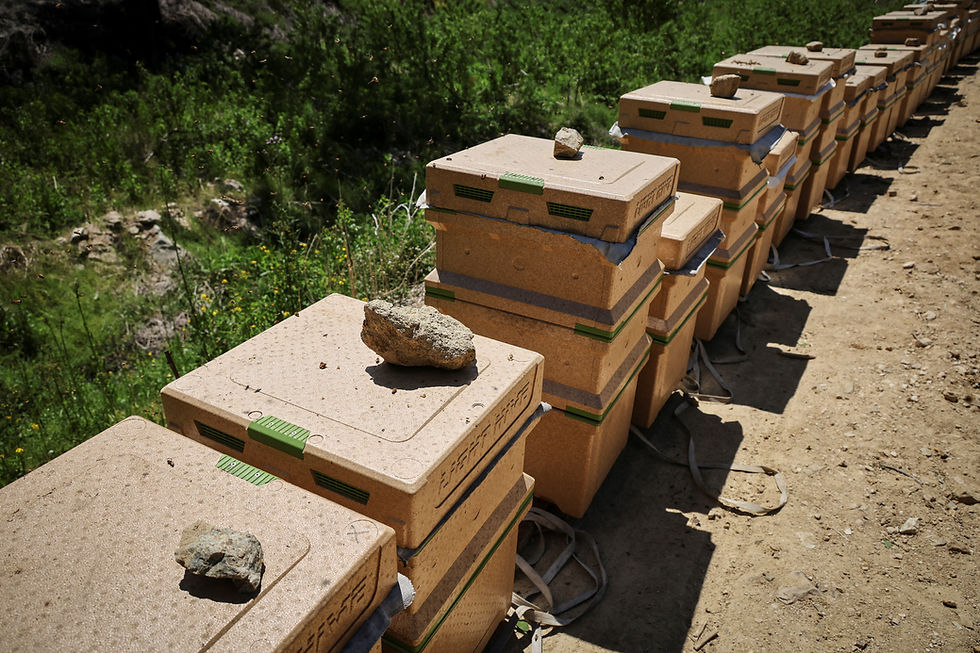
Rocks are placed to protect beehives from strong winds ahead of the second honey harvest at the first location for migratory beekeeping in Gimcheon, South Korea, May 9, 2026. Studies have shown that climate change has harmed bees globally, impacting honey production and many other outdoor and indoor crops, such as apples, strawberries and tomatoes, which need the insects for pollination. i
Kim Hong-Ji /Reuters
Park Gyeong-je started tending beehives almost five decades ago, making it his livelihood because he liked spending time in nature. These days, however, the changing climate is making him question how much longer he and his fellow farmers can survive.
The 65-year-old runs a beekeeping farm in South Korea's southern Sancheong county, but he is a migratory beekeeper, meaning he criss-crosses the country with his hives to chase seasonal flower blooms. Bees gather nectar from the flowers and turn it into honey.
However, rising temperatures due to climate change are shortening seasons, causing flowers to bloom earlier and for shorter periods. The weather changes have also brought strong winds, which can make it harder for bees to find their way back to their hives.
In addition, mites and new diseases have hit the bee population.
"In the past there were big climate differences between southern and central regions, so it was very good for producing honey. But now, because of global warming, flowers seem to bloom all at once nationwide," Park told Reuters as he tended to his hives. He started with just eight back in 1979 and now has about 110. Together, they house roughly 8.8 million bees.
The total bee forage area in South Korea, meanwhile, was 146,000 hectares in 2020, about 70 percent less than it was in the 1970s to 1980s, according to data from the National Institute of Forest Science.
To figure out the best honey-making routes, beekeepers exchange information about where flowers are in bloom and where conditions are good, Park said.
But while in the past Park could make four trips across South Korea to harvest black locust honey, he said premature blooming meant he could do only two trips with honey production taking place on only one to two months of the year.
"The flowers were battered by the wind and withered, so much less honey was made. Compared to previous years, there isn't much honey—our harvest is down by about 50 percent,” said Park after harvesting black locust honey at the first site.
Most honey produced in South Korea is of the black locust variety, which is mild and floral, but there are also other types such as chestnut honey, which is less sweet and more earthy in flavour. In 2024, it exported 8.55 metric tons of natural honey, according to data from the World Integrated Trade Solution platform.
But Ministry of Agriculture data shows the number of hives for migratory beekeeping decreased by 14% to 813,279 from 2014 to 2023.
Studies have shown that climate change has harmed bees globally, impacting honey production and many other outdoor and indoor crops, such as apples, strawberries and tomatoes, which need the insects for pollination.
"The destruction of (bee population), which is at the most fundamental substructure of the ecosystem, is, in many ways, one of the greatest threats to humanity,” said Yeh Sang-Wook, a climate and energy systems engineering professor at Ewha Womans University in Seoul.
The number of households running bee hives plunged by more than a third from 2005 to the end of 2024, but Park is determined to carry on beekeeping. Park intends to expand the scale of his beekeeping operation by introducing smart farming systems including cameras inside the hives to provide real-time updates on the bee colonies' growth.
The South Korea rural development administration, an agency under the agriculture ministry, told Reuters it was planning to breed stronger honeybees that can withstand climate change, plant trees that are attractive to bees because of their abundant nectar and introduce 'smart beekeeping' technologies.
The government said it was investing a total of 48.6 billion won ($32.3 million) through to 2030 for research aimed at restoring bee health.
Production: Minwoo Park, Kim Hong-Ji, Dogyun Kim/Reuters
TOP BUSINESS STORIES

Airline CEOs warn EU plan to expand carbon costs will raise fares

Private jet market defies Iran war gloom as rich flock to Monaco GP, Cannes
_JPG.jpg)
China's global e-commerce push stalls as Iran war lifts costs, dampens demand
LATEST NEWS

Pope Leo tells Spain's Church to listen to abuse survivors, offer reparations

PH lifts tsunami alert after magnitude 7.8 earthquake in Mindanao

Japanese city suspends 94 schools after first-ever bear sighting
GET IN TOUCH
desk@myparaluman.ph
Tektite Towers (East), Exchange Road
Ortigas Center. San Antonio 1600
City of Pasig, NCR, Philippines
+63284298877
MENU
© 2026 Paraluman News Publication