
Australia's farmers, hit by Iran war costs and dry weather, grow less wheat
Australia’s wheat production is expected to decline sharply as soaring fuel and fertilizer costs linked to the Iran war force farmers to cut planting and reduce fertilizer use. Analysts warn the smaller harvest could tighten global wheat supplies and drive food prices higher worldwide.
May 19, 2026
Peter Hobson / Reuters
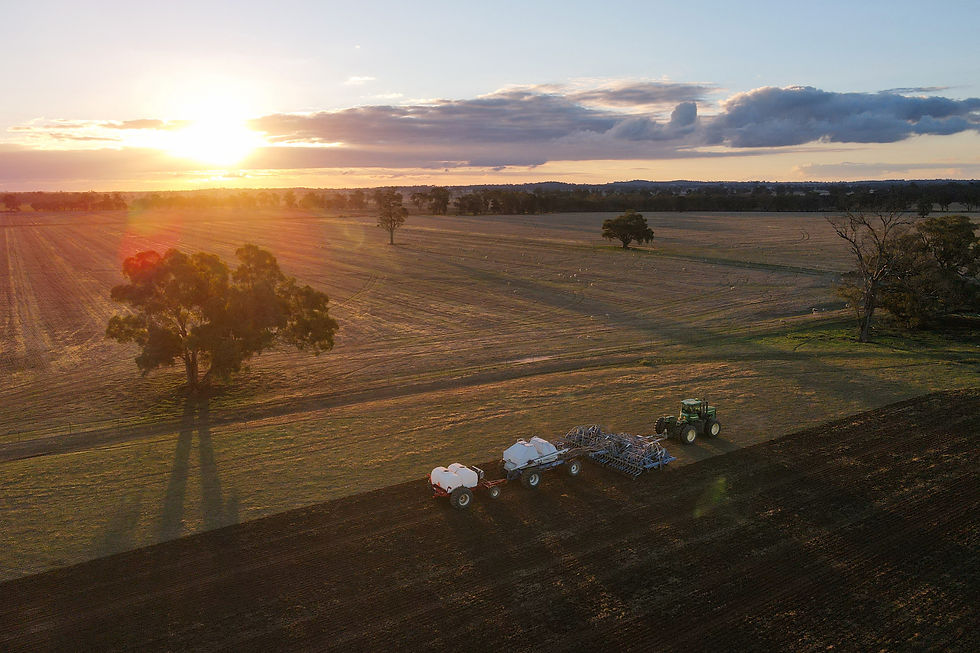
A drone view of Justin Everitt sowing wheat at his farm in Brocklesby, Australia, May 5, 2026.
Hollie Adams / Reuters
Australia’s wheat industry is facing mounting pressure as farmers cut back on planting and fertilizer use due to soaring costs linked to the ongoing conflict in Iran and worsening dry weather conditions.
In Brocklesby, Australia, farmer Justin Everitt said he is planting only half the wheat he originally planned this season after fuel and fertilizer prices surged while rainfall remained scarce. Standing beside his tractor and seeding rig on his family’s sixth-generation farm, Everitt said the current conditions have forced him to make drastic changes he has never experienced before.
“Every indicator is pointing towards lower production,” Everitt said.
Thousands of farmers across Australia are making similar decisions, reducing wheat acreage and scaling back fertilizer use as production costs climb sharply. The trend could significantly impact global grain supply, with analysts warning Australia may export up to 10 million tons less wheat in the upcoming season. That reduction would equal around 5% of annual global wheat exports.
Australia is the world’s third-largest wheat exporter and the first major producer to sow crops since the start of the Iran conflict, which disrupted fuel and fertilizer exports from Gulf nations. The uncertainty has already contributed to rising wheat prices in global markets.
Many farmers are also shifting from wheat to crops such as barley and canola, which require less fertilizer or offer stronger returns. Near the town of Corowa, farmer Anthony Black said he plans to plant 20% less wheat and reduce fertilizer use by one-third. He expects his harvest could fall by as much as 40% due to dry conditions.
“There isn’t money in the budget to absorb a doubling in the price of urea,” Black said, referring to the widely used nitrogen fertilizer.
Agricultural analysts estimate that Australia’s wheat planting area could decline between 7% and 20% compared to last year. If dry conditions continue, the country’s harvest may fall from roughly 36 million tons last season to as low as 21.3 million tons.
The expected decline in Australian production comes as other wheat-exporting nations also face challenges. In Argentina, farmers are projected to plant less wheat because of rising costs, while in Canada, spring sowing has progressed slower than usual.
Experts warned that the global wheat market could shift from surplus to deficit, reducing stockpiles and driving prices higher.
Weather forecasts are adding to farmers’ concerns. Australia’s Bureau of Meteorology expects below-average rainfall across much of the country’s cropping regions between June and September, while forecasters predict the development of an El Niño weather pattern, which typically brings hotter and drier conditions to eastern Australia.
Some growers have chosen not to plant at all this season because of the financial risks. Others, however, remain optimistic in areas that have received enough rainfall.
Farmer Tim McClelland, who operates near Birchip in Victoria state, said favorable rain had given him one of the best starts to a season he had ever experienced. Although fertilizer costs were high, he had already secured his supply.
“I feel a bit sick about the amount of money it cost,” McClelland said. “But positive about the season.”
Fertilizer shortages remain another major concern. Australia normally imports more than half of its nitrogen fertilizers from the Middle East, but shipments have been disrupted by the closure of the Strait of Hormuz.
Hamish McIntyre, president of the National Farmers’ Federation, said Australia still lacks around 600,000 tons of urea compared to normal annual demand. Delays in deliveries could also reduce the effectiveness of fertilizer applications during the growing season.
The economic strain is beginning to spread beyond farms and into rural communities. In Corowa, farm machinery salesman Joe Gorman said demand for equipment had slowed sharply as farmers tightened spending.
“When the farmers feel the pinch, there’s less people at the pub after work,” Gorman said. “There’s less people at the bakery on a Saturday. The supermarkets feel the pinch, the football clubs feel the pinch. It’s a flow-on effect.”
Back in Brocklesby, Everitt is now planting vetch and barley as fodder crops for his sheep while applying only limited fertilizer to save money. However, he warned the strategy is only temporary and could create bigger problems in the future if soil nutrients are not restored.
He said the 2027 season worries him the most.
“We’ll be drawing down on a lot of soil nutrients this year and we’ll have to put them back in next year,” Everitt said. “If we can’t do that, I dare say next year there could be a lot of crop not go in.” -Reporting by Peter Hobson; Additional reporting by Maximilian Heath in Buenos Aires and Ed White in Winnipeg; Editing by Sonali Paul/Reuters
TOP BUSINESS STORIES

Airline CEOs warn EU plan to expand carbon costs will raise fares

Private jet market defies Iran war gloom as rich flock to Monaco GP, Cannes
_JPG.jpg)
China's global e-commerce push stalls as Iran war lifts costs, dampens demand
LATEST NEWS

Pope Leo tells Spain's Church to listen to abuse survivors, offer reparations

PH lifts tsunami alert after magnitude 7.8 earthquake in Mindanao

Japanese city suspends 94 schools after first-ever bear sighting
GET IN TOUCH
desk@myparaluman.ph
Tektite Towers (East), Exchange Road
Ortigas Center. San Antonio 1600
City of Pasig, NCR, Philippines
+63284298877
MENU
© 2026 Paraluman News Publication