
EU prepares to cut US import duties to avoid Trump tariff hike
European Union negotiators are moving to remove import duties on U.S. goods as part of a trade deal agreed with Donald Trump, aiming to avoid a renewed tariff dispute. The talks come amid lingering disagreements over safeguards and enforcement of the agreement.
May 19, 2026
Philip Blenkinsop/Reuters
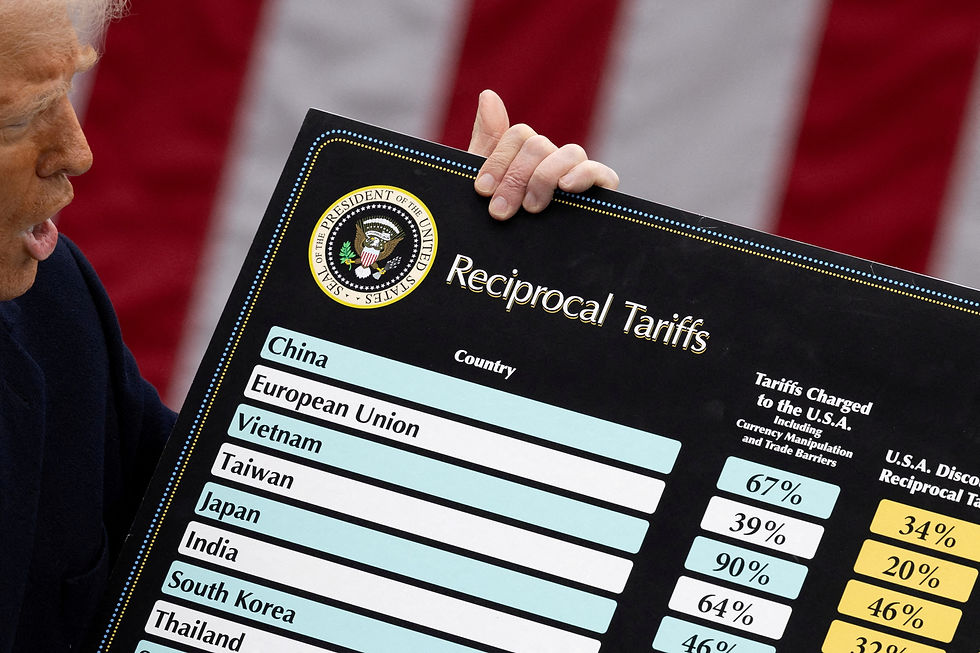
FILE PHOTO: U.S. President Donald Trump delivers remarks on tariffs in the Rose Garden at the White House in Washington, D.C., U.S., April 2, 2025.
Carlos Barria/Reuters
European Union negotiators were expected to agree on Tuesday to scrap import duties on U.S. goods to comply with the trade deal struck with the United States last year and ward off U.S. President Donald Trump's threat of much higher tariffs.
Under the terms of the deal struck at Trump's Turnberry golf resort in Scotland last July, the EU agreed to remove import duties on U.S. industrial goods and grant preferential access to U.S. farm and sea produce. In exchange, the United States would impose tariffs of 15% on most EU goods.
However, nearly 10 months on, the European Parliament and the Council, the body representing EU governments, still have to agree on a legislative text before the EU duty reductions can enter force, with the main divisions over safeguards in case Trump reneges on the agreement.
Negotiators from the parliament and council will meet for what was expected to be a final round of talks starting at 9 p.m. (1900 GMT). EU lawmakers involved in the negotiations were confident a deal would be struck late Tuesday or very early on Wednesday.
TRUMP SET JULY 4 DEADLINE
Trump has said he would impose much higher tariffs on EU goods including cars if the European Union did not implement its trade deal commitments by July 4, having earlier threatened to raise tariffs on EU car imports to 25% from the current 15%.
EU lawmakers have twice paused the required legislation after Trump's threats to impose new tariffs on European allies who did not back his proposed acquisition of Greenland and after the U.S. Supreme Court struck down his global tariffs.
Assuming a deal is reached, then the bloc should meet Trump's July 4 deadline, with a final vote of approval in the European Parliament then expected in mid-June.
EU lawmakers want tougher safeguards, including a "sunrise clause" under which the EU would only cut duties when the United States fulfilled its side of the deal, the possibility to suspend the deal if the U.S. breached the terms, and a "sunset clause" to end EU tariff concessions on March 31, 2028.
EU governments have had less appetite for inserting such items, concerned they could antagonise the Trump administration and create uncertainty for EU businesses.
-Reporting by Philip Blenkinsop; Editing by Alex Richardson/Reuters
TOP BUSINESS STORIES

Airline CEOs warn EU plan to expand carbon costs will raise fares

Private jet market defies Iran war gloom as rich flock to Monaco GP, Cannes
_JPG.jpg)
China's global e-commerce push stalls as Iran war lifts costs, dampens demand
LATEST NEWS

Pope Leo tells Spain's Church to listen to abuse survivors, offer reparations

PH lifts tsunami alert after magnitude 7.8 earthquake in Mindanao

Japanese city suspends 94 schools after first-ever bear sighting
GET IN TOUCH
desk@myparaluman.ph
Tektite Towers (East), Exchange Road
Ortigas Center. San Antonio 1600
City of Pasig, NCR, Philippines
+63284298877
MENU
© 2026 Paraluman News Publication