

ANALYSIS: China's power reforms, global data center buildout usher in battery boom
China’s power-market reforms and surging global demand from renewables and AI data centres are fuelling a boom in energy storage, driving a sharp rise in lithium-ion battery exports and profits. With Chinese firms dominating global cell production, the country is set to capture much of the rapidly expanding $66 billion battery storage investment market.
Colleen Howe/Reuters
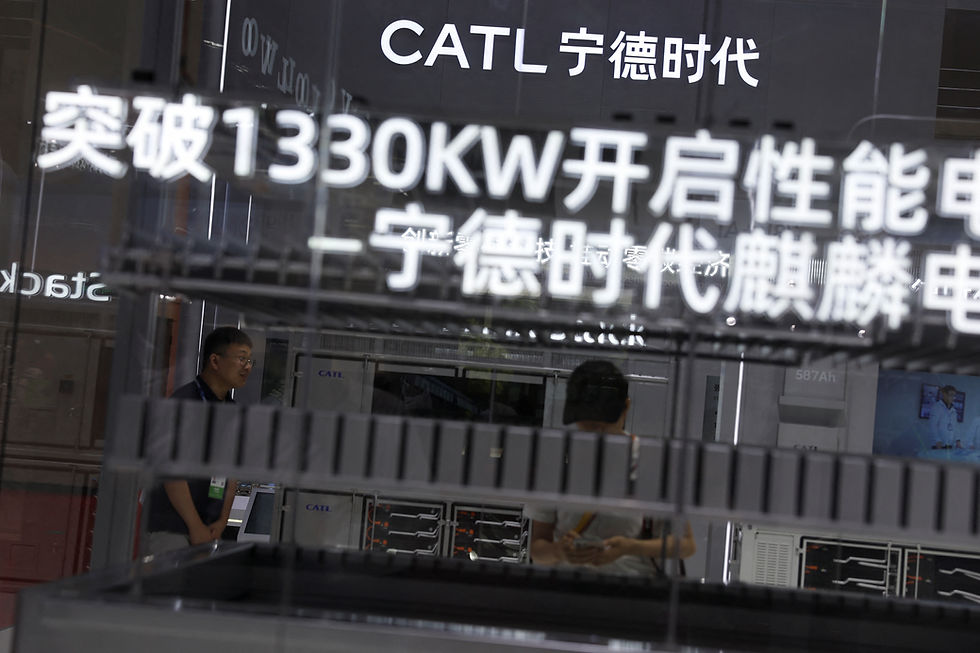
China’s power market reforms and surging global demand for data centres and renewables are driving a boom in energy storage, cementing Chinese battery makers’ dominance of the global market.
Reuters
BEIJING – A sweeping overhaul of China’s electricity market is strengthening the business case for energy storage just as global demand accelerates, fueling a surge for Chinese manufacturers that already dominate the sector worldwide.
Chinese companies are on track to increase global shipments of lithium-ion battery cells for energy storage by about 75% this year, according to one industry estimate.
So far this year, China has exported more than $65 billion worth of energy storage and electric-vehicle batteries, reinforcing its leadership in a sector critical to supporting wind and solar power and ensuring reliable electricity for artificial-intelligence data centers.
Analysts say the surge is being driven by rapid growth in domestic data centers and renewable energy projects, alongside government reforms and subsidies that are lifting demand for energy storage. Overseas demand is also rising, fueled by expanding AI infrastructure, Europe’s aging power grid, and China’s renewable energy projects in the Middle East.
GOING GLOBAL
“These leading energy storage cell makers have full order books. Many are essentially running double shifts to meet demand,” said Cosimo Ries, an analyst at policy research firm Trivium China. “This boom is one of the biggest surprises of the year in China’s energy sector.”
UBS last month raised its forecast for global battery energy storage installations in 2026 by 25%.
The International Energy Agency expects global investment in battery storage facilities to rise 16% this year to $66 billion. A significant share of that growth is likely to benefit Chinese firms. While Tesla leads in energy storage systems, China dominates the production of the battery cells used inside them.
All six of the world’s top energy storage cell suppliers—Contemporary Amperex Technology Co. Ltd. (CATL), HiTHIUM, EVE Energy, BYD, CALB, and REPT BATTERO—are Chinese, according to a January-to-September ranking by consultancy Infolink. Among the top 10 suppliers, only Japan’s AESC is not Chinese.
EVE Energy reported a 35.51% increase in energy storage sales volumes during the first three quarters compared with a year earlier. REPT BATTERO posted record-high battery shipments in the third quarter. Major EV players CATL and BYD have not separately disclosed energy storage shipment figures through the third quarter, as automotive batteries and electric vehicles still account for most of their revenue, though storage is becoming a larger share.
“Pairing solar with storage has effectively become the only viable solution to meet U.S. AI data center power demand,” UBS analyst Yishu Yan said during a media briefing. “AI power demand in the U.S. is very strong, but electricity supply is the biggest bottleneck, and baseload sources—such as gas, nuclear, and thermal—are unlikely to grow significantly over the next five years.”
Yan added, however, that Chinese manufacturers face risks from U.S. rules limiting investment tax credits for projects involving designated “foreign entities of concern,” which include China.
POWER MARKET SHAKE-UP
China’s battery exports, including those for electric vehicles and energy storage, reached a record $66.761 billion in the first 10 months of the year, according to data from energy think tank Ember. Batteries have been China’s most valuable clean-technology export since 2022, overtaking solar photovoltaic products.
That growth is expected to continue next year. Consultancy Infolink projects global energy storage cell shipments could reach 800 gigawatt-hours, representing a 33% to 43% increase from this year’s forecast.
China’s exports of energy storage and other non-automotive batteries rose 51.4% in the first 11 months of the year compared with the same period last year, outpacing the 40.6% growth in EV battery exports, according to the China Electric Vehicle Industry Technology Innovation Strategic Alliance.
China already operates the world’s largest battery energy storage fleet, accounting for about 40% of global capacity. This expansion has been driven partly by local government requirements for wind and solar developers to add storage systems. This year, China’s battery storage capacity surpassed that of conventional pumped hydro, a more geographically constrained technology that relies on water stored behind dams.
Much of that battery capacity, however, had remained underused because it was not profitable to operate.
That is now changing following reforms introduced in June that require new power projects to sell electricity through market-based auctions rather than at fixed rates. The shift has improved profitability for storage operators, who can now charge batteries when prices are low and discharge power when prices are high.
Energy storage facilities operated longer hours in the third quarter after the reforms took effect, averaging 3.08 hours per day—up 0.78 hours from a year earlier and 0.23 hours from the previous quarter—according to the China Electricity Council.
These changes come alongside a new $35-billion government plan to nearly double China’s battery storage capacity by 2027, as well as expanded provincial subsidies. Since late 2024, 10 provinces have introduced capacity tariffs—payments for keeping power capacity on standby—on top of other incentives, according to Jefferies.
“This is the most decisive policy shift for energy storage in more than a decade,” Jefferies analyst Johnson Wan wrote in a research note. -Reporting by Colleen Howe; Editing by William Mallard/Reuters
China’s sweeping power market reforms and surging global demand for reliable energy are driving a boom in battery storage, strengthening the dominance of Chinese manufacturers. With lithium-ion energy storage shipments set to jump sharply this year, Chinese firms are benefiting from rising needs tied to renewable energy expansion and the rapid growth of AI data centres worldwide. Exports have hit record highs, backed by new subsidies, market-based pricing reforms, and massive planned investments, positioning China at the centre of the global energy storage industry even as geopolitical risks loom.
LATEST NEWS

Add a Title
Add a Title
Add a Title

Italians challenged to drive slowly as Rome introduces speed limit in historic center

Kremlin says action needed to avoid repeat of death of nine newborn babies in Siberian hospital

Two dead in Thailand after another crane collapses, crushing cars
TOP SPORTS NEWS
Add a Title
Add a Title
Add a Title

OLYMPICS: No selfies, please: Dolomites push back against overtourism ahead of Games

NBA: Trey Murphy III scores 34 points as Pelicans rally past Nets

TENNIS: Federer hopes 'Sincaraz' rivalry can thrill fans at Australian Open
GET IN TOUCH
MENU
EDITORIAL STANDARDS
© 2025 Paraluman News Publication