
OPINION: To impeach or not to impeach— that is the question
The views and opinions expressed in this article are solely those of the author(s) and do not necessarily reflect the official policy or position of Paraluman News.
Atty. Nena Radoc
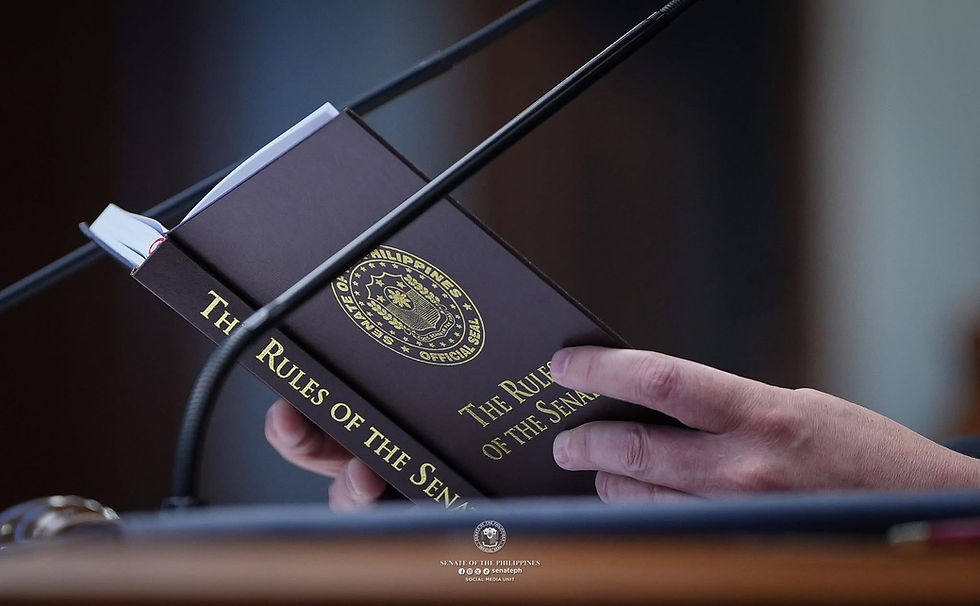
Social Media Unit of the Senate of the Philippines
To borrow from a famous line in William Shakespeare's Hamlet, Filipinos are anxious and divided about the political fate of Vice President Sara Duterte, the daughter of former President Rodrigo Duterte, and herself a presidential frontrunner in the next 2028 elections.
Vice President Duterte is facing her second impeachment case over charges of misuse of confidential funds, unexplained wealth, and grave threats against the President, among others.
The Impeachment Process under the Constitution
The impeachment process in the Philippines is one of the most powerful constitutional mechanisms designed to hold certain high-ranking officials accountable for serious misconduct. It is both a legal and a political process, intended to protect the public from abuses of power while also preserving the stability of government institutions.
The recent impeachment proceedings involving Sara Duterte have brought renewed national attention to how impeachment works, especially after the landmark ruling of the Supreme Court declaring Duterte’s first impeachment complaint as unconstitutional.
Under the 1987 Philippine Constitution, certain officials may be impeached, including the President, Vice President, members of the Supreme Court, members of constitutional commissions, and the Ombudsman.
Impeachment may be initiated for culpable violation of the Constitution, treason, bribery, graft and corruption, other high crimes, or betrayal of public trust. The process begins in the House of Representatives and ends in the Senate, which acts as an impeachment court.
There are generally two methods of initiating impeachment in the House. The first is through the filing of a verified complaint by a member of the House or by a citizen endorsed by a House member.
This complaint is referred to the House Committee on Justice, which determines whether it is sufficient in form and substance. If approved by the committee and later by the plenary, the articles of impeachment are transmitted to the Senate for trial.
The second method is sometimes called the “shortcut” or “fast-track” method. Under this approach, if at least one-third of all House members endorse the complaint, the articles of impeachment may be transmitted directly to the Senate without the need for committee hearings.
The 2025 Duterte Impeachment Saga
The “short-cut” method became central in the impeachment proceedings against Vice President Sara Duterte in 2025. Back then, several impeachment complaints were filed against Duterte.
Eventually, a fourth complaint, reportedly supported by more than one-third of House members, was transmitted to the Senate. However, Duterte challenged the validity of the proceedings before the Supreme Court. In a historic ruling later affirmed with finality in January 2026, the Supreme Court declared the impeachment complaint unconstitutional.
The Court’s decision focused mainly on two constitutional principles: the “one-year bar rule” and due process.
The one-year bar rule is found in Article XI, Section 3(5) of the Constitution, which states that no impeachment proceedings shall be initiated against the same official more than once within a period of one year.
The purpose of this rule is to prevent harassment through repeated impeachment attempts and to preserve governmental stability. The Supreme Court clarified that impeachment may already be considered “initiated” once a properly filed complaint is referred to the House Committee on Justice.
The Court also ruled that even complaints that were not fully acted upon could still trigger the one-year prohibition if the House failed to process them within constitutional timelines. Hence, the earlier complaints filed against Duterte had already triggered the constitutional one-year bar, making the fourth complaint transmitted to the Senate unconstitutional.
The Supreme Court further ruled that the Senate never acquired jurisdiction because the impeachment complaint itself was constitutionally defective. Another significant aspect of the decision involved due process. Although impeachment is political in nature, the Court emphasized that constitutional fairness still applies.
The justices explained that even under the fast-track mode, the respondent must be given adequate notice of the allegations and an opportunity to respond. The Court stressed that constitutional procedures cannot simply be ignored for reasons of political expediency.
The 2026 Duterte Impeachment Case
Despite the ruling, the Supreme Court clarified that Duterte was not absolved of the allegations against her. It merely required that any new complaint comply with the constitutional one-year rule and the procedural standards laid down by the Court.
Following the expiration of the one-year period, new impeachment efforts against Sara Duterte emerged in 2026. Lawmakers attempted to follow the procedural guidelines established by the Supreme Court, including stricter compliance with timelines and due process requirements.
After several hearings, the House Justice Committee found probable cause and elevated the articles to the plenary, which voted to transmit the articles to the Senate by a significant majority vote of 255-26-9 on May 11, 2026.
But the drama has just begun in the Senate, when Senate President Sotto was replaced by a known Duterte ally, Sen. Alan Cayetano. The Senate itself is packed by Duterte allies, raising doubts if the needed 2/3 votes or 16 senators could be mustered to convict Duterte.
The Sara Duterte impeachment controversy may ultimately become one of the most important constitutional episodes in recent Philippine history. It highlighted the delicate balance among the branches of government: the House of Representatives’ power to accuse, the Senate’s authority to try impeachment cases, and the Supreme Court’s role in interpreting the Constitution.
This goes to show that impeachment process in the Philippines is not purely political nor purely judicial. It is a hybrid process where constitutional law and political accountability intersect.
In the end, the impeachment process underscores a central principle of constitutional democracy: public officials may be held accountable, but when and how depend on the politics of the time.
TOP POLITICAL STORIES

IAEA calls on Iran to 're-engage' as West pressures it with resolution

EXPLAINER: Why are Poland and Ukraine at odds about their history?

PNP serves arrest warrant vs. contractor Curlee Discaya in flood control case
LATEST NEWS

Pope Leo tells Spain's Church to listen to abuse survivors, offer reparations

PH lifts tsunami alert after magnitude 7.8 earthquake in Mindanao

Japanese city suspends 94 schools after first-ever bear sighting
GET IN TOUCH
desk@myparaluman.ph
Tektite Towers (East), Exchange Road
Ortigas Center. San Antonio 1600
City of Pasig, NCR, Philippines
+63284298877
MENU
© 2026 Paraluman News Publication