
Political tensions may have hurt PH's bid to join UN Security Council – Palace
Malacañang on Thursday said domestic political tensions may have contributed to the Philippines' unsuccessful bid for a non-permanent seat in the United Nations Security Council (UNSC).
Paraluman News with Reuters
June 4, 2026
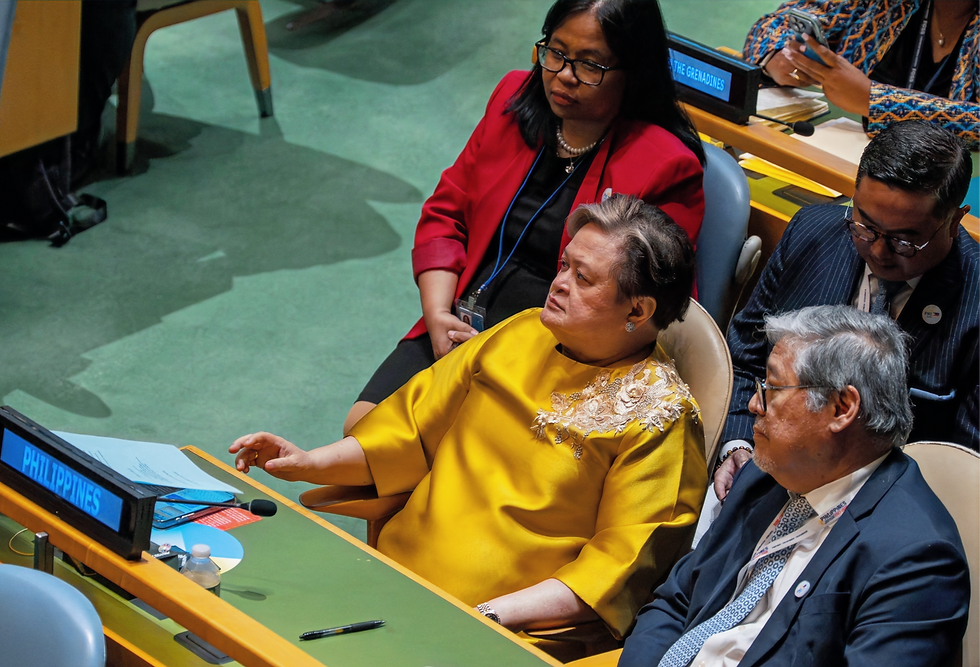
Secretary of Foreign Affairs for the government of the Philippines Theresa 'Tess' Lazaro receives a second ballot after not securing a position in the first round of the election of non-permanent members of the United Nations Security Council at U.N. headquarters in New York City, U.S., June 3, 2026.
David 'Dee' Delgado/Reuters
Malacañang on Thursday said domestic political tensions may have contributed to the Philippines' unsuccessful bid for a non-permanent seat in the United Nations Security Council (UNSC).
According to a report of the Philippine News Agency, Palace Press Officer Claire Castro said local political noise may have influenced the vote despite the campaigning efforts of President Ferdinand R. Marcos Jr.
“Lahat ng political noise, lahat ng political tensions nakakaapekto ito at ito ang nakikita ng buong bayan at buong mundo sa impresyon dito sa Pilipinas,” Castro said.
A Reuters report said the United Nations General Assembly on Wednesday (June 3, 2026) said the contest between the Philippines and Kyrgyzstan for the seat for the Asia-Pacific Group went to four rounds of voting, with Kyrgyzstan eventually achieving the necessary two-thirds majority and securing its first-ever Security Council seat by 142 votes to 49.
READ: Philippines loses to Kyrgyzstan in bid for seat at 15-member UN Security Council
Asidfe from Kyrgyzstan, the UN General Assembly elected Austria, Portugal, Trinidad and Tobago and Zimbabwe to the 15-member U.N. Security Council for two-year terms starting on January 1, 2027.
Germany, which had lobbied hard for a seat, came third for the two places contested by the Western European and Others Group, with 104 votes, against 134 for Portugal and 131 for Austria.
The Security Council is the only UN body that can make legally binding decisions such as imposing sanctions and authorizing use of force.
On its website, the Security Council stated that it takes the lead in determining the existence of a threat to the peace or an act of aggression.
When there is a dispute among countries, the Council can call upon parties involved to help them to settle matters through peaceful means and recommends specific methods of adjustment or terms of settlement.
In certain cases, the Council may impose sanctions or authorizing the use of force to maintain or restore international peace and security.
It has five permanent veto-wielding members: Britain, China, France, Russia and the United States.
The remaining 10 members are elected, with five new members joining every year.
This year, one comes from the Africa Group, one from the Latin American and Caribbean Group, one from the Asia-Pacific Group, and two from the Western European and Others Group.
Zimbabwe will replace Somalia and Trinidad and Tobago will replace Panama, while Portugal and Austria will replace Denmark and Greece. Kyrgyzstan will replace Pakistan.
Bahrain, Colombia, Democratic Republic of Congo, Latvia and Liberia will continue to serve as non-permanent members of the Security Council until the end of 2027.
Meanwhile, the UN General Assembly elected Bangladeshi Foreign Minister Khalilur Rahman as president of the 193-member body for its 81st session, which begins in September.
Paraluman with a report from David Brunnstrom/Editing by David Ljunggren and Sanjeev Miglani/Reuters
TOP POLITICAL STORIES

Witnesses withdraw allegation that Senator Legarda received cash-laden luggage

Lebanese Prime Minister says Israel has bombed Lebanon nearly 3,500 times during ceasefire

Senator Cayetano orders steps to keep impeachment trial on schedule amid Senate row
LATEST NEWS

Pope Leo tells Spain's Church to listen to abuse survivors, offer reparations

PH lifts tsunami alert after magnitude 7.8 earthquake in Mindanao

Japanese city suspends 94 schools after first-ever bear sighting
GET IN TOUCH
desk@myparaluman.ph
Tektite Towers (East), Exchange Road
Ortigas Center. San Antonio 1600
City of Pasig, NCR, Philippines
+63284298877
MENU
© 2026 Paraluman News Publication