

OLYMPICS: Price of glory: Rising costs putting Alpine skiing out of reach for some young talents
The thrill Alpine skiers delivered during the Milano Cortina Olympics may soon become more difficult to achieve for aspiring youngsters as new generations of athletes struggle with the soaring costs of a sport that is becoming increasingly elite.
Sara Rossi/Reuters
February 20, 2026
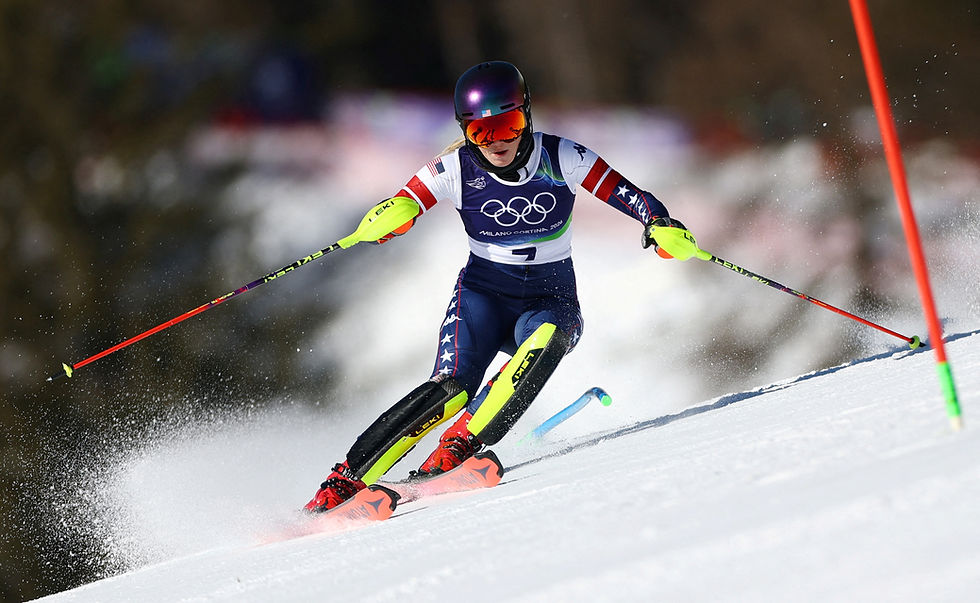
FILE PHOTO: Milano Cortina 2026 Olympics - Alpine Skiing - Women's Slalom Run 1 - Tofane Alpine Skiing Centre, Belluno, Italy - February 18, 2026. Mikaela Shiffrin of United States in action during her first run in the women's slalom.
Lisi Niesner/Reuters
CORTINA D'AMPEZZO- The thrill Alpine skiers delivered during the Milano Cortina Olympics may soon become more difficult to achieve for aspiring youngsters as new generations of athletes struggle with the soaring costs of a sport that is becoming increasingly elite.
For most skiers competing in the International Ski and Snowboard Federation World Cup and Europa Cup - the second-tier circuit mostly dedicated to younger athletes - sponsors cover most expenses such as skis, suits and safety gear.
But for those who are starting out on the road to become champions, it is the family who must shoulder all the costs.
For a mid-level 16-year-old talent, annual expenses amount to at least 20,000 euros ($23,526.00), coaches and experts said.
The costs include coaches, ski club fees, which vary widely depending on location, at least six pairs of skis costing about 1,000 euros each, travel, race entry fees and ski passes.
"Skiing is becoming more and more a sport for the rich, and rising costs are discouraging many families - this is already a problem," Andorra's women's team captain Roger Vidosa told Reuters.
In Andorra - a 468 square km (180.7 square miles) country in the Pyrenees and a host venue on the World Cup circuit - Alpine skiing is a national sport and many ski clubs invest in young talent.
"When clubs see that a kid is talented but the family cannot afford the expenses, they step in and cover the costs to encourage young talents," Vidosa said.
Expenses increase further when young athletes are required to train not only on weekends but also during the week and in the summer months.
WIDESPREAD PROBLEM
"This is a general issue that affects not only smaller national teams - it's an even bigger problem for larger teams with more athletes," Vidosa said.
Thanks to its extensive mountainous terrain, Italy has one of the largest youth talent pools in Europe, with just under a thousand athletes practicing competitive Alpine skiing from the age of 16.
However, neither the Italian Winter Sports Federation (FISI) nor the ski clubs can afford to support talented young athletes without financial means because the expense would be too high.
"Until an athlete becomes part of the national team, all costs are entirely covered by the family. And for an athlete to reach a certain level by age 15, the family must start spending significant amounts at least five years earlier," said Paolo Deflorian, technical director of the FISI youth sector.
Things start to improve when Italian athletes start to compete in the World Cup or Europa Cup. In addition to having costs covered, they have the chance to join a military sports group, earning a monthly net salary of around 1,200 euros.
"In Italy, sponsorships are managed personally by the athlete and, for example, in the Europa Cup securing one is not easy," Deflorian added.
In the euro zone's third-largest economy, skiing has become an elite sport and young talents who once came from mountain areas - where they could ski more frequently - have dropped sharply, replaced by those from cities who can afford the expense, Deflorian added.
FALLING SUBSCRIPTIONS
In Cortina, one of the most exclusive resorts in the Italian Alps, ski clubs have experienced a drop in membership over the past decade, not only due to rising costs but also to a decline in the birth rate - a chronic issue for Italy that is felt even more in a small mountain town where only about 5,000 people live year-round.
"The economic issue accounts for 30%, the demographic decline for 40%, and the remaining 30% is due to the fact that we've lost that healthy competitive spirit we had 40 years ago," said Adolfo Menardi, president of the Cortina ski club, founded in 1903, explaining the reasons behind the membership fall.
Menardi served as a coach to Italian retired downhiller Kristian Ghedina, who was born in Cortina and grew up in the local ski club, where annual membership fees for a 16-year‑old competitive athlete now reach 5,000 euros.
To support large families, the Cortina branch of the international women's advocacy organisation Soroptimist is offering from the 2024–25 ski season a 1,000-euro scholarship for promising young female athletes in Alpine skiing.
The project - aimed at helping them pursue their competitive careers - will run for three years.
HOPE FROM THE SOUTH
The technical director of the FISI youth sector Delforian said that Italy is nevertheless witnessing a shift.
"On the other hand, Italy has recently seen an increase in athletes coming from the south, where there is no long-standing skiing tradition due to the absence of high mountains," he said.
Giada D'Antonio, the youngest skier on Italy's women's alpine team and seen as a rising star, is one example.
D'Antonio, who suffered an ACL tear during training last week, was born in Naples to an Italian father and Colombian mother and began skiing in the resort of Roccaraso, in the southern Abruzzo region.
($1 = 0.8501 euros)
Reporting by Sara Rossi, editing by Ken Ferris/Reuters
TOP SPORTS STORIES

Add a Title
Add a Title
Add a Title

OLYMPICS: Freestyle-China's Wang Xindi wins gold in men's aerials

OLYMPICS: Freestyle world champion Melville Ives suffers bad crash in Milano Cortina Olympics
OLYMPICS: Price of glory: Rising costs putting Alpine skiing out of reach for some young talents
LATEST NEWS
Add a Title
Add a Title
Add a Title

Seven dead after Chinese tour bus plunges into frozen Lake Baikal in Russia

Spanish court prevents father from blocking paraplegic daughter's euthanasia

British co-founder of fashion retailer ASOS dies after falling from balcony in Thailand
GET IN TOUCH
MENU
EDITORIAL STANDARDS
© 2025 Paraluman News Publication