
Maersk beat first-quarter profit expectations but kept its full-year outlook unchanged, citing heightened uncertainty from the Iran conflict and volatility in global shipping markets. The company warned that rising energy costs and disruptions in key trade routes could weigh on container demand and freight rates in 2026.
Maersk profit beats forecasts, Iran war clouds outlook
Maersk beat first-quarter profit expectations but kept its full-year outlook unchanged, citing heightened uncertainty from the Iran conflict and volatility in global shipping markets. The company warned that rising energy costs and disruptions in key trade routes could weigh on container demand and freight rates in 2026.
May 07, 2026
Enrique Flores, David O'Sullivan/Reuters
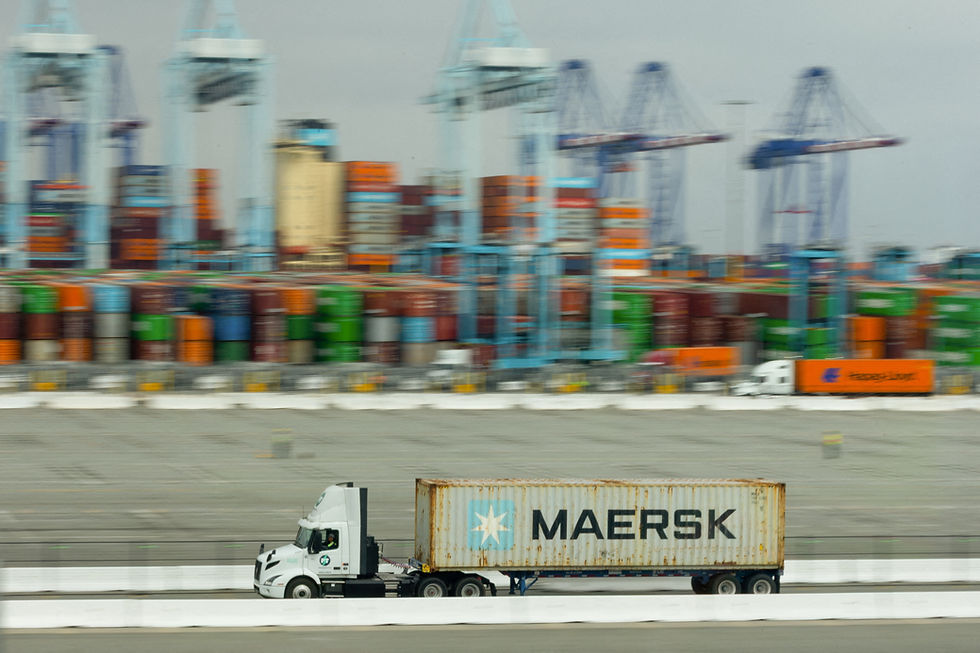
FILE PHOTO: A truck transports a Maersk container at APM Terminals at the Port of Los Angeles, California, U.S., March 4, 2026.
Mike Blake/Reuters
Shipping group Maersk MAERSKb.CObeat first-quarter profit forecasts on Thursday (7 May) but kept its full-year earnings guidance unchanged, warning the Iran war had clouded the outlook for freight rates and costs.
Maersk, which is often seen as a bellwether for global trade, still projects global container volume growth of between 2% and 4% this year but cautioned that the situation remained volatile.
"The outlook for global container demand in 2026 is highly uncertain. Higher energy prices and constraints on trade in the Upper Gulf region, which in 2025 accounted for around 6% of global container trade, pose downside risks to the growth momentum," the company said in a statement.
Its earnings before interest, tax, depreciation, and amortisation (EBITDA) for the January-March period came in at $1.73 billion, compared to a median forecast of $1.66 billion in a company-provided poll of 10 analysts but well below the $2.71 billion for the same period a year ago.
The first quarter does not capture the Middle East war's full impact on global supply chains as the conflict began on February 28 when the United States and Israel launched coordinated strikes on Iran.
The war has disrupted shipping routes across the region after Iran closed the Strait of Hormuz to commercial traffic, pushing up costs such as fuel.
Maersk said freight rates fell during the quarter due to continued capacity oversupply before rising sharply toward the end of the period following the outbreak of the war in the Middle East.
Some analysts have warned, however, that the war could weigh on Maersk's earnings, as freight rates on the Asia-Europe route have nearly returned to pre-war levels while fuel costs remain elevated.
-Enrique Flores, David O'Sullivan/Reuters
TOP BUSINESS STORIES

Add a Title
Add a Title
Add a Title

China, Hong Kong stocks end higher on US-Iran peace deal hopes

Iran war to accelerate China's shift to electric trucks from diesel
_JPG.jpg)
France preps aid for airlines hit by jet fuel price hikes
LATEST NEWS
Add a Title
Add a Title
Add a Title

Senator Legarda pushes bill to declare waling-waling as PH's National Orchid

Strike hits southern Lebanon as Israel campaign carries on

Countries scramble to track passengers of virus-hit cruise ship
PARALUMAN NEWS
GET IN TOUCH
desk@myparaluman.ph
Tektite Towers (East), Exchange Road
Ortigas Center. San Antonio 1600
City of Pasig, NCR, Philippines
MENU
EDITORIAL STANDARDS
© 2025 Paraluman News Publication